
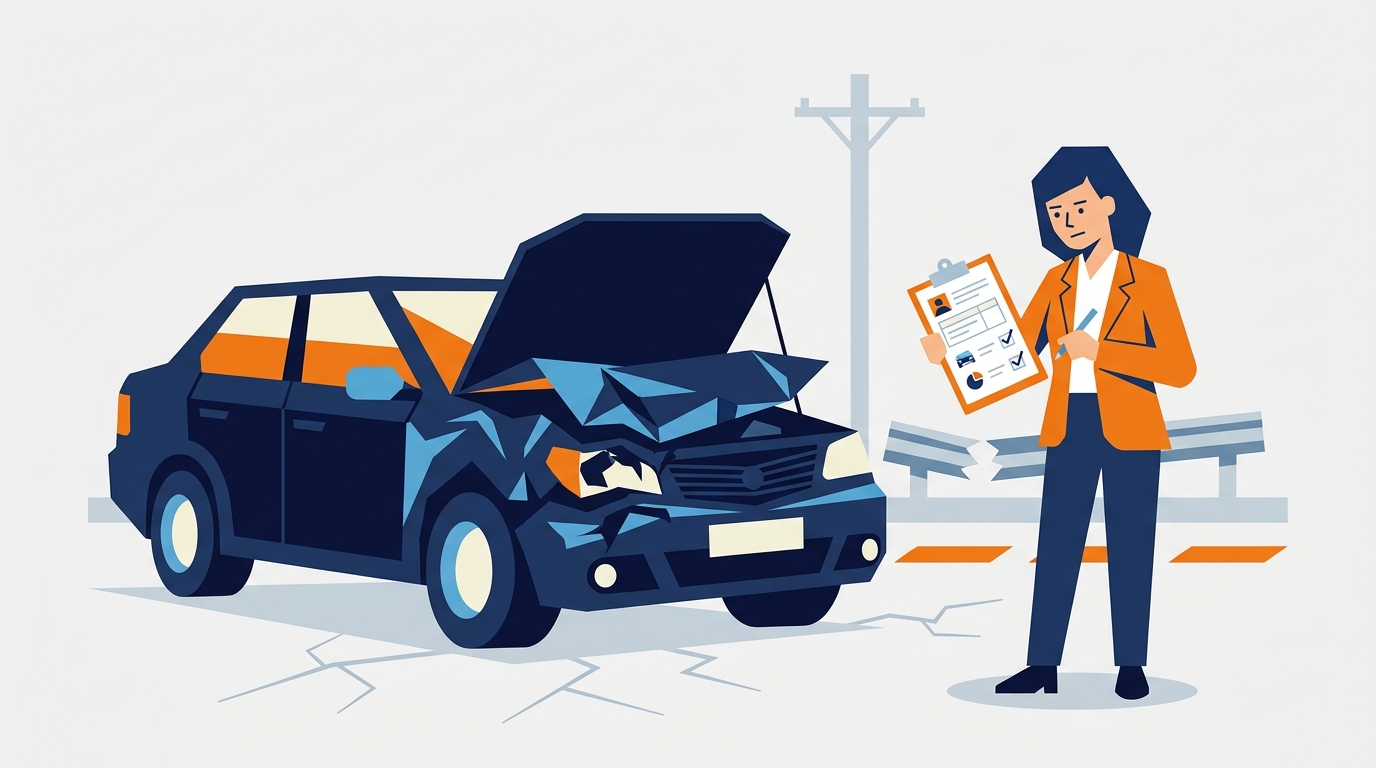
Quick answer: A vehicle is considered a total loss when the insurance company determines that the cost to repair it exceeds its actual cash value (ACV). New York does not set a fixed percentage threshold. Instead, insurers use the Total Loss Formula: if repair costs plus salvage value exceed the car’s ACV, it’s totaled. In practice, most New York insurers declare a total loss once repairs reach 75-80% of ACV. If your car is totaled, you receive the ACV minus your deductible — and if you owe more than that on your loan, gap insurance covers the difference.
Key Takeaways
- New York uses the Total Loss Formula (TLF) — repair cost + salvage value > ACV = total loss. There is no fixed percentage threshold set by New York State law.
- In practice, most insurers total a car at 75-80% of ACV because salvage value accounts for the remaining 20-25%, pushing the formula over the threshold.
- You receive the actual cash value minus your deductible — not what you paid for the car or what you owe on your loan. ACV reflects the car’s fair market value immediately before the accident.
- Gap insurance is critical if you’re financing — 30.9% of trade-ins in early 2026 carried negative equity averaging $7,183 (Edmunds, Q1 2026). Gap coverage costs only $20-50/year and covers the shortfall.
- You can negotiate the insurer’s offer — policyholders who challenge the initial total loss settlement receive 10-20% more on average, according to consumer advocacy data.
What Does “Total Loss” Mean in Car Insurance?
A vehicle is declared a total loss — commonly called “totaled” — when your insurance company determines that repairing the vehicle would cost more than the vehicle is worth. Instead of paying for repairs, the insurer pays you the vehicle’s actual cash value (ACV), minus your deductible.
According to the Insurance Information Institute (III), approximately 20% of all auto insurance claims result in a total loss declaration. That number has been climbing since 2020 due to rising repair costs, parts shortages from supply chain disruptions, and the increasing complexity of modern vehicle technology — sensors, cameras, and advanced driver-assistance systems (ADAS) that make even minor repairs significantly more expensive.
The total loss determination is not a judgment call by a single adjuster. It follows a formula or threshold defined by state law (or insurer policy, depending on the state). How that formula works varies significantly from state to state, which is why understanding your state’s specific rules matters.
Two Methods Insurers Use to Determine Total Loss
Across the United States, there are two primary approaches for deciding whether a vehicle is totaled:
| Method | How It Works | Used By |
|---|---|---|
| Total Loss Threshold (TLT) | Fixed percentage — the car is totaled when repair costs exceed X% of ACV. Thresholds range from 50% to 100% depending on the state. | ~30 states (e.g., NJ at 100%, PA at 100%, CT at 100%) |
| Total Loss Formula (TLF) | Repair cost + salvage value > ACV = total loss. No fixed percentage — the math determines the outcome. | New York and ~18 other states |
New York uses the Total Loss Formula. This means there is no fixed statutory percentage cutoff. Instead, the insurer adds the estimated repair cost to the vehicle’s salvage value (what it would sell for at a salvage auction). If that combined total exceeds the vehicle’s ACV, the car is declared a total loss.
New York Total Loss Threshold — What NY Drivers Need to Know
If you’re searching for the “New York total loss threshold,” you’ll find conflicting information online because New York technically does not have a threshold. Unlike New Jersey, Connecticut, or Pennsylvania — which each set a fixed percentage — New York uses the Total Loss Formula (TLF), which is a calculation rather than a cutoff.
How the NY Total Loss Formula Works in Practice
Here’s a real-world example of how a New York insurer would apply the Total Loss Formula:
| Vehicle ACV (pre-accident value) | $20,000 |
| Estimated repair cost | $14,000 |
| Salvage value (auction estimate) | $4,500 |
| Repair + Salvage | $14,000 + $4,500 = $18,500 |
| Result | $18,500 < $20,000 ACV — NOT a total loss |
Now change the repair estimate to $16,000:
| Repair + Salvage | $16,000 + $4,500 = $20,500 |
| Result | $20,500 > $20,000 ACV — TOTAL LOSS |
Because salvage values typically run 20-25% of ACV, the effective “threshold” in New York ends up being around 75-80% in most cases. But it’s not a rule — it’s just how the math usually works out.
Where the famous “75%” figure actually comes from: New York’s salvage-title rule. The NY DMV requires a title to be branded “REBUILT SALVAGE: NY” when a vehicle 8 model years old or newer is damaged so that repair costs exceed 75% of its retail value at the time of loss (the MV-907A salvage certificate). That is a title-branding threshold, not an insurer-settlement rule — the two get conflated constantly online.
Know your settlement rights — sales tax is owed to you: insurer total-loss settlements in New York are governed by DFS Regulation 64 (11 NYCRR 216.6). Under it, your actual cash value settlement must include sales tax (8.875% in NYC) and title/transfer fees, calculated before any salvage deduction. On a $20,000 ACV settlement in Queens, that is roughly $1,775 of sales tax the insurer owes you. If your offer doesn’t itemize it, push back — they are required to pay it.
NY DMV Salvage Title Requirements
Once a vehicle is declared a total loss in New York, the NY DMV gets involved. Here’s what happens:
- Salvage certificate (Form MV-907A): The insurer files this form with the DMV, which brands the title as “salvage.” This becomes part of the vehicle’s permanent history.
- If you keep the vehicle: You’ll receive a salvage title. Before you can register and drive the vehicle again, it must pass a salvage inspection (Form MV-83) at a DMV-approved inspection station to verify that all repairs were completed safely and that no stolen parts were used.
- Rebuilt title: After passing the salvage inspection, the vehicle receives a “rebuilt salvage” title. This title brand follows the vehicle forever and significantly affects resale value — typically reducing it by 20-40%.
- Insurance on a salvage title: Getting full coverage on a rebuilt salvage vehicle is harder. Many insurers will only offer liability coverage — not collision or comprehensive — because the vehicle’s value is harder to establish after being totaled.
NY No-Fault Insurance and Total Loss Claims
New York is a no-fault state, which causes confusion during total loss situations. Here’s what you need to understand:
- No-fault (PIP) covers medical expenses and lost wages only — it does not apply to vehicle damage of any kind.
- Your vehicle damage is handled through collision coverage on your own policy (if you have it) or through the at-fault driver’s property damage liability coverage.
- If you only carry NY minimum coverage (liability + PIP), your own vehicle’s damage is not covered at all. You would receive nothing for your totaled car unless the other driver was at fault and had property damage liability coverage.
- Rental car reimbursement: If you carry rental reimbursement coverage, you’re entitled to a rental vehicle during the claims process — typically up to 30 days or until the settlement is paid, whichever comes first.
How Insurance Companies Determine Your Car’s Value
The actual cash value (ACV) is the single most important number in a total loss claim. It determines your payout, whether you agree with it or not — at least initially. Here’s how insurers arrive at that number.
Valuation Tools Insurers Use
Most insurance companies use one of three third-party valuation platforms:
- CCC Intelligent Solutions (CCC ONE): The most widely used platform. Analyzes local market data, recent sales, and vehicle condition to produce a valuation report.
- Mitchell International: Another major platform that generates comparable vehicle valuations using regional sales data.
- Audatex (Solera): Used by some carriers for both estimating repairs and determining ACV.
These tools pull data from dealer listings, auction results, and private-party sales within your geographic area to find comparable vehicles (“comps”) — same year, make, model, trim, and similar mileage.
Factors That Affect Your Car’s ACV
- Year, make, model, and trim level: The starting point for any valuation. A 2022 Honda Civic EX is worth more than a 2022 Honda Civic LX.
- Mileage: Lower mileage generally means higher value. The average American drives about 13,500 miles per year — if your car has significantly less, your ACV should be higher.
- Condition before the accident: Was the interior in good shape? Were there pre-existing dents, scratches, or mechanical issues? The insurer assesses condition as it was immediately before the crash.
- Vehicle history: A clean Carfax with no previous accidents, one owner, and complete service records adds value. Prior accidents reduce ACV.
- Optional equipment and upgrades: Factory-installed options (navigation, premium sound, sunroof) typically add value. Aftermarket modifications (custom wheels, lift kits, aftermarket exhaust) usually do not — or add very little.
- Local market conditions: Car values vary by region. A 4WD SUV is worth more in upstate New York than in Manhattan, where parking is a premium and public transit is dominant. Valuation tools account for your zip code.
- Current market trends: Used-car prices remain elevated in 2026 — the average used vehicle sells for roughly $26,000 (Kelley Blue Book, 2026), and the average paid gap claim has climbed to $4,987 (Assurant, Q1 2026). Higher values cut both ways: your ACV payout is bigger, but so is the loan balance many drivers carry.
Total Loss Thresholds by State — NY, NJ, CT, PA Compared
If you’re insured through K&N Insurance Brokerage, you may have policies in multiple states. Here’s how total loss rules compare across the states we serve:
| State | Method | Threshold / Formula | Key Notes |
|---|---|---|---|
| New York | Total Loss Formula (TLF) | Repair + Salvage > ACV | No fixed %. Effective threshold ~75-80%. Salvage inspection (MV-83) required to re-register. |
| New Jersey | Total Loss Threshold (TLT) | 100% of ACV | Repairs must exceed full ACV. Very high bar — harder for insurers to total a car. Salvage title issued if totaled. |
| Connecticut | Total Loss Threshold (TLT) | 100% of ACV | Same as NJ — repairs must exceed full value. Vehicle may be repaired even with heavy damage. |
| Pennsylvania | Total Loss Threshold (TLT) | 100% of ACV | 100% threshold. PA also requires a salvage inspection before a rebuilt title can be issued. |
What this means for you: If the same car is involved in the same accident, it might be totaled in New York (where salvage value is factored in) but not totaled in New Jersey (where only repair cost vs. ACV matters and the threshold is 100%). The state where the vehicle is registered and insured determines which rules apply.
Source: National Association of Insurance Commissioners (NAIC) and individual state insurance department regulations.
What Happens After Your Car Is Totaled — Step by Step
The total loss process can feel overwhelming, especially if it’s your first time. Here’s exactly what to expect, from the accident to the final settlement check:
Step 1: File the Claim and Get an Inspection
After the accident, file a claim with your insurer (or the at-fault driver’s insurer). An adjuster will inspect the vehicle — either in person at a body shop or tow yard, or remotely using photos you submit. The adjuster generates a repair estimate listing every damaged part and the labor required to fix it.
Step 2: The Insurer Calculates ACV
Using CCC, Mitchell, or Audatex, the insurer determines your vehicle’s actual cash value — what it was worth immediately before the crash. This is based on comparable sales in your local market, your vehicle’s condition, mileage, and options. The ACV is not what you paid for the car, what you owe on it, or the Kelley Blue Book retail price.
Step 3: Total Loss Determination
In New York, the insurer applies the Total Loss Formula: repair cost + salvage value vs. ACV. If the repair plus salvage exceeds the ACV, the vehicle is declared a total loss. You’ll receive a letter or call from the adjuster notifying you of the decision.
Step 4: Settlement Offer
The insurer offers you the ACV minus your deductible. For example:
- ACV: $18,000
- Deductible: -$500
- Settlement offer: $17,500
You are not required to accept the first offer. You have the right to review the valuation report, challenge it with your own evidence, and negotiate. We cover how to do this effectively below.
Step 5: Title Transfer
Once you accept the settlement, you sign over the vehicle’s title to the insurer. The insurer takes possession and sells the vehicle at a salvage auction. In New York, the DMV issues a salvage certificate (Form MV-907A) for the vehicle.
Step 6: Payment
Payment typically arrives within 7-14 days of accepting the offer. Under NY Insurance Regulation 64, the insurer must make a claim decision within 30 business days of receiving all required documentation. If you have a lien on the vehicle, the check goes directly to your lienholder. Any remaining amount after the loan is paid off goes to you.
Step 7: If You Want to Keep the Car
You can keep a totaled vehicle in New York, but:
- The insurer deducts the salvage value from your settlement
- The vehicle receives a salvage title
- You must pass a salvage inspection (Form MV-83) at a DMV-approved station before you can register and drive it again
- Future insurance options will be limited — many carriers only offer liability on rebuilt salvage vehicles
Gap Insurance — What Happens When You Owe More Than Your Car Is Worth
According to Edmunds, 30.9% of trade-ins in early 2026 involved drivers “upside down” on their auto loans — the highest share since 2021, with the average shortfall at $7,183 — meaning they owe more than their vehicle is currently worth. If your car is totaled while you’re upside down, you’re responsible for paying the difference between the insurance payout and your remaining loan balance out of your own pocket.
Here’s how that plays out:
| Vehicle ACV | $18,000 |
| Your deductible | – $500 |
| Insurance payout | = $17,500 |
| Remaining loan balance | $22,000 |
| YOU OWE out of pocket | $4,500 |
Gap insurance (Guaranteed Asset Protection) covers this exact shortfall. If you had gap coverage in the example above, the gap policy would pay the $4,500 difference — you’d owe nothing.
Who Needs Gap Insurance?
You should strongly consider gap coverage if:
- You put less than 20% down when you bought or leased your vehicle
- Your loan term is 60 months or longer
- You drive a vehicle that depreciates quickly (most new cars lose 20-30% of their value in the first year)
- You rolled negative equity from a previous loan into your current one
- You’re leasing — many lease agreements require gap coverage, and some include it
How Much Does Gap Insurance Cost?
When added as an endorsement to your existing auto insurance policy, gap coverage typically costs $20-$50 per year — far less than the thousands of dollars it could save you. This is significantly cheaper than buying gap insurance through a dealership at the time of purchase, which can cost $500-$700 as a one-time fee.
Ask your broker about adding gap coverage before you need it. Once your car is totaled, it’s too late. Call K&N Insurance Brokerage at (718) 739-9090 to add gap insurance to your policy today.
How to Negotiate a Higher Total Loss Settlement
The insurer’s first offer is not always their best offer. According to consumer advocacy organizations, policyholders who negotiate their total loss settlement receive 10-20% more on average. Here are five proven steps to get what your car is actually worth.
1. Get Your Own Valuation
Check your vehicle’s value on Kelley Blue Book (kbb.com), Edmunds, and NADA Guides. Look specifically for the “private party value” in “good” or “very good” condition — not trade-in value, which is lower and not the right comparison. Save or print these reports to reference during negotiations.
2. Document Your Vehicle’s Condition
If your car was in better-than-average condition, had recent maintenance, new tires, a fresh set of brakes, or any upgrades, document everything with receipts. The insurer’s automated valuation tool may not account for these improvements. Photos taken before the accident (dashcam footage, Instagram posts, service records) are valuable evidence.
3. Find Local Comparable Sales
Search for the same year, make, model, trim, and similar mileage selling in your area on Autotrader, Cars.com, CarGurus, and Facebook Marketplace. If similar vehicles are listed for $2,000 more than the insurer’s offer, that’s strong evidence your ACV is higher. Screenshot the listings — they can change or disappear.
4. Request and Review the Insurer’s Valuation Report
Ask for the CCC or Mitchell report the insurer used. Check it carefully for errors: wrong mileage, incorrect options or trim level, missing features, or comparable vehicles pulled from a different geographic area. Errors in the valuation report are your strongest basis for a higher offer — they’re objective mistakes the insurer must correct.
5. Submit a Written Counter-Offer
Don’t just call and argue. Put your counter-offer in writing with supporting evidence. Be specific: “Your offer of $14,500 undervalues my vehicle. Three comparable 2021 Honda Civic EX vehicles in the Queens/Long Island area are currently listed at $16,500-$17,200 with similar mileage. Based on this evidence, I am requesting a revised offer of $16,800.”
“I’ve seen clients accept the first total loss offer and leave thousands on the table. The insurer’s valuation is a starting point — not a final answer. Before you sign anything, call your broker. We’ll review the valuation report, pull comparable sales in your area, and help you build a counter-offer that gets you what your car is actually worth. That’s what brokers do — we work for you, not the insurance company.”
— A K&N Insurance broker with 30+ years of experience
What Counts Toward the Repair Cost in a Total Loss Calculation?
The repair estimate isn’t just the visible body damage. Insurance adjusters factor in everything required to return the vehicle to its pre-accident condition:
- Body and structural repairs: Panel replacement, frame straightening, welding
- Paint and finish: Primer, base coat, clear coat, color matching, blending adjacent panels
- Mechanical repairs: Engine, transmission, suspension, steering, and brake system damage
- ADAS recalibration: Modern vehicles have cameras, radar, and sensors behind bumpers, grilles, and windshields. After a collision, these systems must be recalibrated — often costing $1,000-$3,000 per system
- Parts: OEM (original manufacturer) parts vs. aftermarket. OEM parts cost more but are typically what insurers use in their estimates for newer vehicles
- Labor: Hourly body shop labor rates in New York range from $50-$75/hour, higher in the five boroughs
- Hidden damage: Damage discovered during teardown that wasn’t visible during the initial inspection. This is common and can push a “repairable” car into total loss territory after work has started
Important: If the body shop discovers additional damage during repairs — a cracked subframe hidden behind a bumper, for example — the insurer writes a supplement to the original estimate. If the supplemental damage pushes the total above the ACV threshold, the vehicle can be re-classified as a total loss mid-repair.
Frequently Asked Questions About Total Loss Car Insurance
What is considered a totaled car?
A totaled car is a vehicle that the insurance company has determined costs more to repair than it’s worth. In New York, the insurer uses the Total Loss Formula: if the repair cost plus the vehicle’s salvage value exceeds its actual cash value (ACV), the car is totaled. In states with a fixed threshold (like NJ, CT, and PA at 100%), the car is totaled only when repair costs alone exceed that percentage of ACV.
What is the total loss threshold in New York?
New York does not have a fixed percentage threshold. It uses the Total Loss Formula (TLF): repair cost + salvage value must exceed the vehicle’s ACV for it to be declared a total loss. Because salvage values typically equal 20-25% of ACV, the effective threshold in New York works out to approximately 75-80% in most cases — but this is not a statutory number.
Can I keep my car after it’s totaled in New York?
Yes. You can keep a totaled vehicle in New York. The insurer will deduct the salvage value from your settlement payout. The vehicle will receive a salvage title from the NY DMV. Before you can register and drive it again, you must complete repairs and pass a salvage inspection (Form MV-83) at a DMV-approved inspection station. The vehicle will then carry a “rebuilt salvage” title permanently.
How long does the total loss claim process take?
The process typically takes 2-4 weeks from the date of the accident. The insurer needs time to inspect the vehicle, obtain repair estimates, calculate ACV, and process payment. Under NY Insurance Regulation 64, the insurer must make a claim decision within 30 business days of receiving all required documentation. Delays can occur if there’s a lien on the vehicle, disputes over the valuation, or difficulty locating comparable vehicles.
Does a total loss affect my car insurance rates?
It depends on fault. If you were at fault in the accident, your premium will likely increase at renewal — typically 20-40% for an at-fault accident claim, according to industry data. If you were not at fault, the total loss itself should not directly increase your rate, though the claim will appear on your CLUE (Comprehensive Loss Underwriting Exchange) report for 5-7 years. Some carriers offer accident forgiveness programs that waive the first at-fault surcharge.
What if I disagree with the insurance company’s total loss valuation?
You have the right to dispute the offer. Start by requesting the insurer’s valuation report (CCC or Mitchell) and checking it for errors. Gather your own evidence: KBB/Edmunds valuations, local comparable sales listings, and documentation of your vehicle’s condition. Submit a written counter-offer with supporting evidence. If you still can’t reach an agreement, most New York auto policies include an appraisal clause — both you and the insurer hire independent appraisers, and a neutral umpire resolves the difference.
What is gap insurance and do I need it?
Gap insurance (Guaranteed Asset Protection) covers the difference between your car’s ACV and your remaining loan or lease balance if the car is totaled. It costs $20-$50 per year when added to your auto policy — far less than the dealership charges ($500-$700). You should consider gap insurance if you put less than 20% down, have a loan over 60 months, or drive a vehicle that depreciates quickly. Call (718) 739-9090 to add gap coverage.
How does total loss work with a leased vehicle?
When a leased vehicle is totaled, the insurance payout goes to the leasing company (the lienholder), not to you. If the ACV payout is less than the remaining lease balance — which is common, especially in the first two years — you’re responsible for the difference unless you have gap insurance. Many lease agreements require gap coverage, and some lessors include it automatically. Check your lease contract or ask your broker to verify whether you’re covered.
Related Car Insurance Resources
Explore more car insurance guides from K&N Insurance Brokerage:
- Car Insurance in New York — Complete guide to auto insurance coverage, requirements, and how to get the best rate in NY
- Car Insurance in Queens, NY — Coverage options, rates, and local factors for Queens drivers
- Car Insurance in Huntington, NY — Auto insurance for Long Island drivers in Huntington and surrounding areas
- What You Need to Know About Cosmetic Damage on a Car — When cosmetic damage is worth a claim vs. paying out of pocket
Dealing With a Total Loss? We Can Help.
K&N Insurance Brokerage helps New York drivers understand their settlement, negotiate a better offer, add gap insurance, and find the right coverage for their next vehicle — all in one call.
¿Hablas español? ¡Sí, hablamos español!
Or email us: [email protected]
This article is for informational purposes only and does not constitute legal, financial, or insurance advice. Total loss calculations, thresholds, and settlement procedures vary by insurer, policy, and state. Consult your insurance broker or a licensed attorney for guidance specific to your situation. New York salvage title rules per NY DMV. State threshold data via NAIC. Industry statistics from the Insurance Information Institute (III).
Last updated: August 2026 | K&N Insurance Brokerage • 182-03 Jamaica Ave, Hollis, NY 11423 • 1730 E Jericho Tpke, Huntington, NY 11743
Coverage Questions