
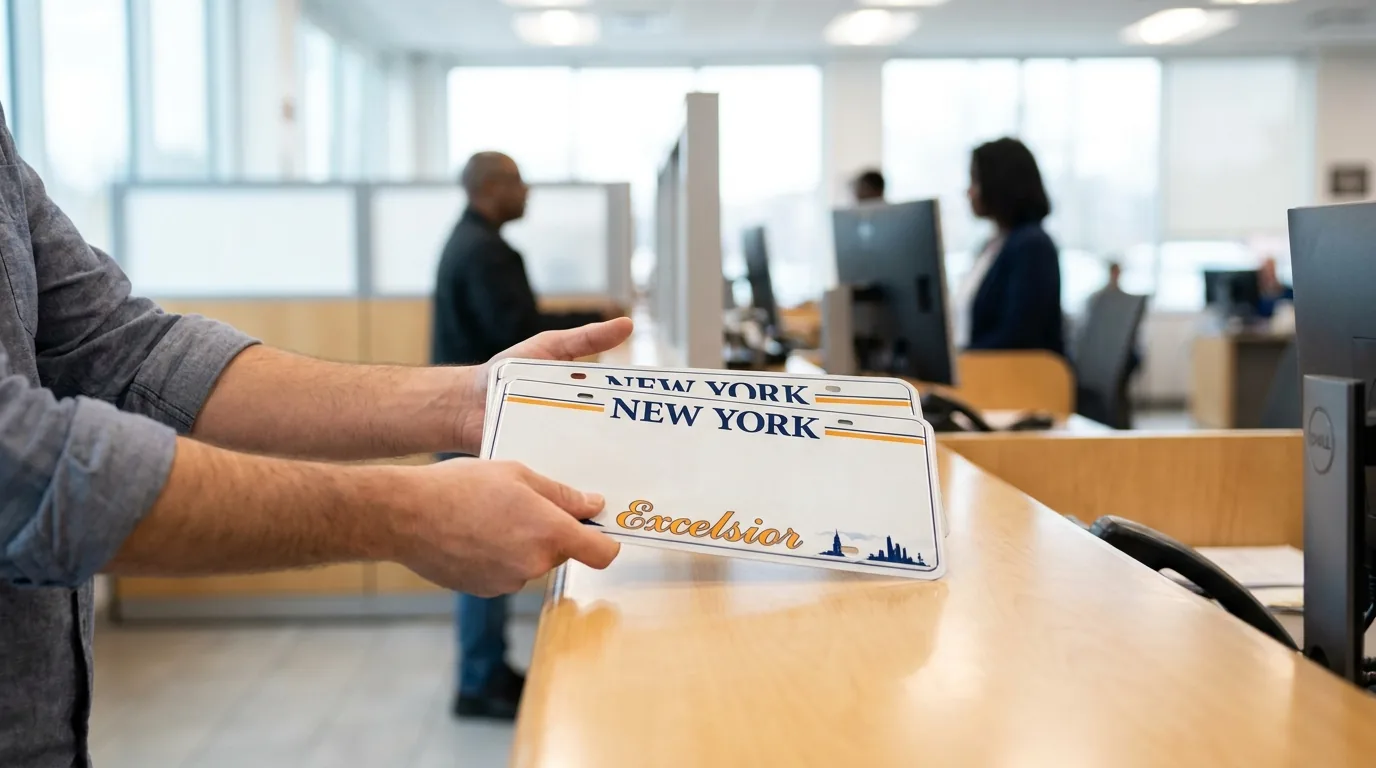
How to Surrender Your License Plates in New York (and Avoid an Insurance Lapse)
Surrendering your plates the right way — and the receipt you walk away with — is what keeps a parked car from turning into hundreds of dollars in DMV penalties.
Call (833) 840-8500¿Hablas español? ¡Sí! Llámanos: (718) 739-9090
Quick answer: To surrender your plates in New York, return them to any DMV office in person or mail them to the DMV, and keep the FS-6T plate surrender receipt as proof of the surrender date. The smart move is to surrender plates before you cancel your insurance — that way no lapse is ever recorded with the DMV. Surrendering also lets you avoid the daily lapse civil penalty if your car will sit uninsured.
Key Takeaways
- Surrender before you cancel. Turn in your plates and get the FS-6T receipt first, then cancel coverage — and no insurance lapse is ever recorded.
- The FS-6T receipt is your proof. It documents the exact date your registration stopped being active. Without it, the DMV has no record you surrendered.
- You can surrender in person or by mail. Any DMV office takes plates over the counter; you can also mail them to the DMV.
- For a lapse of 90 days or less, you have a choice: pay the tiered civil penalty and keep your plates, or surrender your plates and serve a registration suspension equal to your uninsured days.
- Over 90 days, surrender is mandatory — plus a driver license suspension and a $50 reinstatement fee.
What It Means to Surrender Your Plates in New York
In short: Surrendering plates means physically returning them to the DMV, which ends the active registration tied to those plates. The DMV issues an FS-6T receipt recording the date. From that date, the car is no longer registered — so it no longer needs continuous insurance, and you can stop coverage cleanly.
Surrendering your plates in New York means physically returning your registration plates to the DMV, which ends the active registration tied to those plates. You hand them over in person or mail them in, and the DMV issues you an FS-6T receipt recording the date. From that date forward, the car is no longer registered — so it no longer needs continuous insurance.
This matters because New York ties your insurance obligation to your registration, not to whether the car is parked. As long as plates are active, the state expects the vehicle to carry continuous coverage and verifies it electronically. Stop paying for insurance while the plates are still active and the DMV records a lapse — even if the car never moves. Surrendering the plates is how you legally pause the registration so you can stop coverage cleanly.
People surrender plates for all kinds of reasons: selling a car, moving out of state, storing a vehicle for the winter, a car that’s no longer drivable, or simply switching insurers and worrying about a gap. In 30+ years brokering New York auto policies, K&N has walked clients through DMV lapse notices that started with one avoidable mistake — canceling the policy before dealing with the plates.
How and Where to Surrender Plates — In Person or by Mail
In short: You can surrender New York plates two ways — in person at any DMV office, or by mail to the DMV. In person is fastest because you receive your FS-6T receipt on the spot; by mail, the DMV processes the plates and sends the receipt back. Either way, the FS-6T is the proof that protects you.
You can surrender New York plates two ways: in person at any DMV office, or by mail to the DMV. In person is fastest because you receive your FS-6T receipt on the spot. By mail, the DMV processes the plates and sends the receipt back to you. Either way, the FS-6T is the proof that protects you — never throw the plates in the trash.
Option 1 — In Person (fastest)
- Take both plates off the vehicle (front and rear). Bring any hardware or covers off so only the plates remain.
- Bring the plates to any New York State DMV office. You do not have to use the office where you registered.
- Hand the plates to the clerk and request a plate surrender.
- Receive your FS-6T receipt before you leave. Confirm the date and plate number are correct.
Option 2 — By Mail
- Remove both plates from the vehicle.
- Package the plates securely and mail them to the DMV per the current mailing instructions on dmv.ny.gov.
- Use a trackable mailing method so you can prove the date you sent them.
- The DMV processes the surrender and mails your FS-6T receipt back to you. Keep it with your vehicle records.
Important: Surrendering plates ends your registration. It does not, by itself, cancel your insurance policy — that’s a separate call to your broker or insurer. The order you do these in is everything, and we’ll cover that next.
The FS-6T Receipt — Why This Little Slip of Paper Matters So Much
In short: The FS-6T is the official receipt the DMV gives you when you surrender plates. It records the exact date your registration ended — the date the DMV checks your insurance-active window against. It is your evidence there was no coverage gap. Photograph it, file the original, and never assume the DMV “just knows” you turned in the plates.
The FS-6T is the official receipt the DMV gives you when you surrender your plates. It records the exact date your registration ended — and that date is the dividing line that decides whether you owe an insurance lapse penalty. Treat the FS-6T like a deed: photograph it, file the original, and never assume the DMV “just knows” you turned in the plates.
Here’s why it’s the single most important document in this whole process. If you cancel insurance and the DMV later sends a lapse notice, the FS-6T is your evidence that the registration was already inactive on the date in question. The surrender date on that receipt is what the DMV checks the insurance-active window against. No receipt means no proof — and disputing a lapse without it is a losing battle.
“The clients who get blindsided by a lapse penalty are almost never the ones who kept their FS-6T. After 30+ years handling New York auto policies, our rule is simple: surrender the plates, get the receipt, then call us to stop the coverage. Do it in that order and a lapse never even happens.” — a senior K&N Insurance Brokerage broker
Save a digital copy too. If you sell the car, move out of state, or reinsure later, that FS-6T is the cleanest way to show there was never a coverage gap on the registration.
The Prevention Move — Surrender BEFORE You Cancel Coverage
In short: The one move that prevents a lapse entirely is to surrender your plates first, then cancel insurance. Once the plates are surrendered and you hold the FS-6T, the registration is inactive — so canceling coverage afterward creates no gap the DMV can record. Doing it backwards is what causes almost every avoidable penalty.
The one move that prevents an insurance lapse entirely: surrender your plates first, then cancel your insurance. Once the plates are surrendered and you’re holding the FS-6T, the registration is inactive — so canceling coverage afterward creates no gap the DMV can record. This is exactly what K&N does for clients who are storing, selling, or pausing a vehicle.
The mistake that causes almost every avoidable penalty is doing it backwards. If you cancel the policy while the plates are still active, your insurer files an electronic notice with the DMV that coverage stopped — and because New York verifies coverage electronically, the DMV immediately starts counting uninsured days against the active registration. The car can be sitting in your driveway untouched and the meter still runs.
The right order, step by step
- Remove and surrender the plates (in person or by mail).
- Get and save the FS-6T receipt.
- Then contact your broker or insurer to cancel or pause the policy, effective on or after the surrender date.
How you turn it back on later
When you’re ready to drive the car again, you reinstate by re-insuring it. Your insurer files an FS-1 electronically with the DMV confirming active coverage, and you re-register the vehicle and get plates. There is no special form for you to chase — the electronic filing does the talking. New York does not use or require an SR-22; the state confirms coverage through these electronic filings, so a typical New York driver never needs one. (An SR-22 only becomes relevant if another state specifically requires it of you — see Do You Need an SR-22 in New York?)
When Surrendering Beats Paying the Penalty
In short: If your car will sit uninsured, surrendering the plates usually beats paying the lapse penalty, because the penalty is charged per uninsured day on a rising scale. New York’s civil penalty is tiered — $8/day for days 1–30, $10/day for days 31–60, and $12/day for days 61–90. Surrendering stops that clock.
If your car will sit uninsured, surrendering the plates usually beats paying the lapse penalty — because the penalty is charged per uninsured day on a rising scale, and a longer gap gets expensive fast. New York’s civil penalty is tiered: $8/day for days 1–30, $10/day for days 31–60, and $12/day for days 61–90. Surrendering stops that clock.
| Days of Lapse | Daily Civil Penalty Rate | Running Total Example |
|---|---|---|
| Days 1–30 | $8 per day | 25 days = $200 |
| Days 31–60 | $10 per day | 60 days = $240 + $300 = $540 |
| Days 61–90 | $12 per day | 90 days = $240 + $300 + $360 = $900 |
Rules and figures as of 2026 — verify current amounts at dmv.ny.gov/insurance/pay-an-insurance-lapse-civil-penalty.
Lapse of 90 days or less — you have a choice
For a lapse of 90 days or less, New York gives you two options: (a) pay the civil penalty and keep your plates, or (b) surrender your plates and serve a registration suspension equal to the number of uninsured days. If the gap is short and you need to keep driving the car, paying the penalty may be worth it. If the car is going to sit anyway, surrendering avoids the penalty entirely.
One catch on the “pay and keep” option: it is not available if you used it within the prior 36 months. This is a 36-month lookback — not literally a “first lapse vs. second lapse” rule. If you paid to keep your plates within the last three years, surrendering becomes your path this time.
Lapse over 90 days — surrender is mandatory
If the lapse runs more than 90 days, the choice disappears. You must surrender your plates and serve a registration suspension equal to the uninsured days. On top of that, your driver license is suspended for the same number of days, and there is a $50 reinstatement fee. This is the scenario that turns a forgotten policy into a real headache — and why surrendering early, before a gap stretches past 90 days, is so important.
Decision Tree — Surrender, Pay the Penalty, or Stay Insured?
In short: Your best move depends on three things — whether you’ll keep driving the car, how long the gap is, and whether you’ve used the “pay and keep” option in the last 36 months. If the car will sit, surrender before canceling. If you need it on the road, the penalty path may fit. Walk the questions below.
Use this quick decision tree to figure out your best move. The right answer depends on whether you’ll keep driving the car, how long the gap is, and whether you’ve used the “pay and keep” option recently.
1. Will you keep driving this car soon?
• No — it’ll sit (storage, sale, moving out of state): Surrender the plates before canceling coverage. Get the FS-6T. No lapse, no penalty. ✅ Best case.
• Yes — I need it on the road: Go to question 2.
2. Has a lapse already happened?
• No, not yet: Just keep continuous coverage — let your broker shop your renewal so you never create a gap.
• Yes, there’s a gap: Go to question 3.
3. Is the lapse 90 days or less?
• Over 90 days: Surrender is mandatory — plates surrendered, registration + license suspension, $50 reinstatement. Re-insure to reinstate.
• 90 days or less: Go to question 4.
4. Did you “pay the penalty and keep your plates” within the last 36 months?
• Yes: The pay-and-keep option is off the table — surrender the plates and serve the suspension.
• No: Your choice — pay the tiered penalty and keep driving, or surrender and serve a suspension equal to your uninsured days. If the car’s going to sit, surrender. If you need it now, pay.
Not sure which branch you’re on? That’s exactly the kind of call K&N handles for clients every week. Call (718) 739-9090 and we’ll map it out with you in five minutes.
An Insurance Lapse Is Not the Same as Driving Without Insurance
In short: An insurance lapse is an administrative DMV matter under VTL §318 — no court, just a civil penalty or a plate surrender. Being convicted of driving without insurance is a far more serious court matter under VTL §319: a fine, possible jail, license revoked at least a year, plus a separate $750 DMV penalty to restore the license.
An insurance lapse is an administrative DMV matter under VTL §318 — there’s no court, no judge, just the DMV’s civil penalty or a plate surrender and suspension. Being convicted of driving without insurance is a completely different and far more serious thing under VTL §319 — that’s a court matter, not just a DMV letter.
A lapse means your coverage stopped while the registration was active. The DMV mails a notice, and you resolve it by paying the tiered civil penalty or surrendering your plates. No criminal record, no courtroom.
A conviction for actually driving an uninsured vehicle is far harsher: a fine, possible jail, your driver license revoked for at least one year, plus a separate $750 DMV civil penalty to restore the license afterward. The takeaway: never drive a vehicle you know is uninsured. If a car is going to be uninsured, surrender the plates and park it — don’t risk a §319 conviction. For the full breakdown, see Driving Without Insurance in New York: Penalties.
Source: dmv.ny.gov/insurance/about-insurance-lapses. Rules and figures as of 2026 — verify current amounts at dmv.ny.gov.
Getting Back on the Road — New York Minimum Coverage
In short: To re-register and put plates back on, you’ll need at least New York’s minimum coverage in place. Your insurer files the FS-1 electronically to confirm it, then you re-register. New York’s state minimums, per the Department of Financial Services, are listed below — and re-insuring is the perfect moment to compare rates.
When you’re ready to re-register and put plates back on the car, you’ll need at least New York’s minimum required coverage in place. Your insurer files the FS-1 electronically to confirm it, and you re-register the vehicle. Below are New York’s state minimums, per the Department of Financial Services.
- Bodily injury liability: $25,000 per person / $50,000 per accident (and $50,000 / $100,000 in cases involving death).
- Property damage liability: $10,000 per accident.
- No-fault (PIP): $50,000.
- Uninsured motorist: $25,000 per person / $50,000 per accident.
Source: New York Department of Financial Services, dfs.ny.gov. Rules and figures as of 2026 — verify current amounts at dmv.ny.gov.
Re-insuring is also the perfect moment to make sure you’re not overpaying. A broker can compare your renewal across multiple carriers in one shot. See New York Minimum Car Insurance Requirements for the full coverage breakdown, or cheap car insurance in New York for ways to lower your rate.
Frequently Asked Questions About Surrendering Plates in New York
Do I have to surrender my plates if I cancel my car insurance in New York?
Not legally required — but it’s the smart move if the car will sit. As long as the plates are active, New York expects continuous coverage, so canceling insurance without surrendering plates starts a lapse and a daily civil penalty. If you won’t be driving the car, surrender the plates first, keep the FS-6T receipt, then cancel coverage — and no lapse is recorded.
Where do I surrender license plates in New York?
At any New York State DMV office in person, or by mail to the DMV. In person is fastest because you get your FS-6T plate surrender receipt on the spot. By mail, the DMV processes the plates and mails the receipt back — use a trackable method so you can prove the send date.
What is an FS-6T receipt and why does it matter?
The FS-6T is the official receipt the DMV gives you when you surrender your plates. It records the exact date your registration ended, which is the date the DMV checks your insurance-active window against. It’s your proof there was no coverage gap — keep the original and a digital copy.
Is it cheaper to surrender my plates or pay the New York lapse penalty?
If the car will sit uninsured, surrendering is usually cheaper because the lapse penalty is charged per day on a rising scale — $8/day for days 1–30, $10/day for days 31–60, and $12/day for days 61–90 (a full 90-day lapse is $900). If you need to keep driving and the gap is short, paying the penalty to keep your plates may make sense.
Do I need an SR-22 to get my registration back in New York?
No. New York does not use or require an SR-22. The state confirms coverage electronically — your insurer files an FS-1 when you re-insure, and you re-register the vehicle. An SR-22 would only matter if another state specifically requires one of you as a New York resident.
What happens if my insurance lapse goes over 90 days?
For a lapse over 90 days you must surrender your plates and serve a registration suspension equal to your uninsured days, your driver license is suspended for the same number of days, and there’s a $50 reinstatement fee. Surrendering plates early — before a gap stretches past 90 days — avoids the license suspension entirely.
Related New York Car Insurance Guides
Handling a lapse or a plate surrender is one piece of staying compliant in New York. These K&N Insurance Brokerage guides cover the rest:
- Car Insurance Lapse in New York — what a lapse is, what it costs, and how to fix it.
- Got a NY Insurance Lapse Notice? What to Do — step-by-step response to a DMV lapse letter.
- Driving Without Insurance in New York: Penalties — the §319 conviction side and why it’s far worse than a lapse.
- New York Minimum Car Insurance Requirements — the exact coverage you need to re-register.
- Do You Need an SR-22 in New York? — the short answer and the one exception.
- Car Insurance in New York | Car Insurance in Queens | Cheap Car Insurance
Pausing, Selling, or Storing a Car? Don’t Risk a Lapse.
K&N Insurance Brokerage will time your plate surrender and coverage change in the right order so a lapse never happens — and shop multiple carriers when you’re ready to get back on the road.
Explore our car insurance options or call us today.
This article is for informational purposes only and is not legal or insurance advice. DMV rules, penalties, and dollar amounts can change — rules and figures are as of 2026; verify current amounts at dmv.ny.gov. Contact K&N Insurance Brokerage for guidance about your specific situation.