Commercial Insurance in New York — The Complete Guide for Business Owners
New York generally requires workers’ compensation coverage for businesses with covered employees, subject to specific exemptions and coverage rules. Business-owned vehicles generally need a commercial auto policy; other work use depends on the vehicle and policy terms. General liability may be required by a lease or contract. Ask K&N Insurance Brokerage to help compare actual policy terms and prices for your business.
936+ Google reviews
Rated 4.9-5.0 stars on Google across all office locations. Trusted by New York business owners since 2018.
Independent Broker
Ask which insurers can review your business and compare the actual terms of available proposals.
5 Languages
English, Spanish, Arabic, French, and Russian. Hablamos español — insurance is complicated enough without a language barrier.
Why Commercial Insurance Matters in New York
New York businesses may need coverage under state law, contracts, or both. The NY Department of Financial Services offers small-business insurance guidance; check the applicable requirements and policy terms for your operation.
Insurance gaps can leave a business paying for losses that a suitable policy might cover. The Insurance Information Institute (III) offers general insurance information; compare policy limits, exclusions, and deductibles before choosing.
Buying tip: List the people, property, vehicles, and work involved, then ask which proposals cover those exposures and where exclusions or limits apply.
General insurance-shopping tip
Types of Commercial Insurance for New York Businesses
Every business has a unique risk profile. Here are common commercial insurance products and questions to ask about their fit:
General Liability Insurance
General liability can respond to covered third-party bodily injury, property damage, and advertising injury claims, subject to policy terms and exclusions. New York does not generally mandate it for every business, but a lease, contract, or license may require it. Check limits and covered operations against your actual obligations. Compare actual proposals; there is no standard monthly price.
Commercial Auto Insurance
A business-owned vehicle generally needs a commercial auto policy. For a personally owned vehicle used for work, tell the insurer who owns it, who drives it and how it is used. A personal policy may allow some work use or may exclude it; confirm the actual policy before relying on coverage. Ask for a vehicle-specific quote and compare terms.
Business Owners Policy (BOP)
A Business Owners Policy (BOP) commonly packages general liability and commercial property coverage. Eligibility and included coverages vary by policy; business interruption may be included or offered under the policy terms. Compare a BOP proposal with separate policies at the same limits, deductibles, and exclusions before deciding which offers better value. Price depends on the actual quote.
Workers’ Compensation Insurance
New York workers’ compensation coverage is generally required for businesses with covered employees, including many part-time, seasonal, and family workers; specific exemptions and classifications depend on the facts. The New York Workers’ Compensation Board explains who must be covered and how penalties apply when required coverage is missing. Check your status and obtain an actual quote.
Landlord Insurance
Rental-property coverage can address building damage, owner liability, and lost rent after a covered loss, depending on the policy. A homeowners policy may limit or exclude rental use; tell the insurer how the property is occupied. For a multi-family home, apartment building, or commercial rental, compare actual proposals for building coverage, liability, loss of rent, deductibles, and exclusions. The landlord’s policy generally does not insure a tenant’s belongings.
Professional Liability (Errors & Omissions)
Professional liability (errors and omissions) may respond to covered claims arising from errors, omissions, or alleged failures in professional services. Consultants, accountants, architects, engineers, IT providers, and other service businesses should review the services insured, limits, defense costs, exclusions, and any contract or licensing requirements in actual proposals. Coverage depends on the policy and claim facts.
Cyber Liability Insurance
Cyber insurance may help with certain breach-response, network-recovery, cyber-extortion, business-interruption, or liability costs, depending on the policy. The IBM Cost of a Data Breach Report describes a global research average, not the expected loss for an individual small business. New York’s SHIELD Act sets safeguards for covered private information and notice duties for qualifying breaches; the actual data and event matter. Compare covered events, response services, limits, exclusions, security conditions, and notice requirements.
How Much Does Commercial Insurance Cost in New York?
Commercial insurance premiums depend on the operation, coverage, limits, deductibles, and insurer. The NAIC offers general small-business insurance guidance. Use the prompts below with actual proposals on the same terms:
| Coverage Type | Inputs to disclose | Terms to compare | Question to ask |
|---|---|---|---|
| General Liability | Operations and third-party exposures | Liability limits, exclusions, premium | What limits does your lease or contract require? |
| Workers’ Compensation | Payroll, job classes, covered workers | Required benefits, classifications, premium basis | Does WCB require coverage for this business? |
| Business Owners Policy (BOP) | Property, location, covered operations | Property/liability terms, deductibles, exclusions | How does the package compare with separate policies? |
| Commercial Auto | Ownership, drivers, actual vehicle use | Auto liability/physical damage terms, premium | Are all drivers and uses addressed? |
| Professional Liability | Professional services and clients | Covered services, claim conditions, limits | Do exclusions fit the actual work? |
| Cyber Liability | Data handled and system exposure | Incident response, limits, exclusions | Which events and services are included? |
| Landlord Insurance | Property, occupancy, rental income | Building/liability/loss-of-rent terms | What vacancies or uses change coverage? |
Note: Use actual proposals to record each premium, limit, deductible, exclusion, and condition. Ask the insurer or broker to explain material differences before choosing.
New York Commercial Insurance Requirements
New York coverage requirements depend on the business, its workers, vehicles, and contracts. Check the applicable rules and any contractual requirements before relying on a policy:
Workers’ Compensation — Check Coverage Requirements
The New York Workers’ Compensation Board generally requires coverage for businesses with covered workers, including many part-time, seasonal, and family workers. Specific exemptions and classification rules depend on the facts. When coverage is required but missing, consequences may include:
- Civil penalties determined under the applicable Workers’ Compensation Board rules
- Criminal penalties under qualifying circumstances
- Responsibility for benefits or assessments arising from an uninsured worker injury
- Other enforcement action under the applicable facts and law
Commercial Auto — Check Business Vehicle Coverage
A business-owned vehicle generally needs a commercial auto policy. When an employee uses a personal car for work or the business rents a vehicle, ask what coverage applies to the business and driver. A personal policy may allow some work use or may exclude it. Review the vehicle ownership, drivers, actual use and policy terms with the insurer; see NY DFS guidance for general business insurance context.
General Liability — Check Lease and Contract Terms
General liability is not universally required by New York law. Some leases, contracts, and licenses require it, with limits and wording set by the actual document or rule. Ask which obligation applies and compare available policy terms.
Disability Benefits — Check Employer Requirements
New York disability benefits coverage may be required for covered employers and workers, subject to exemptions and eligibility rules. It provides wage benefits for qualifying off-the-job injuries or illnesses and is distinct from workers’ compensation for work-related injuries. The NY Workers’ Compensation Board explains coverage requirements and exemptions.
Industries We Serve
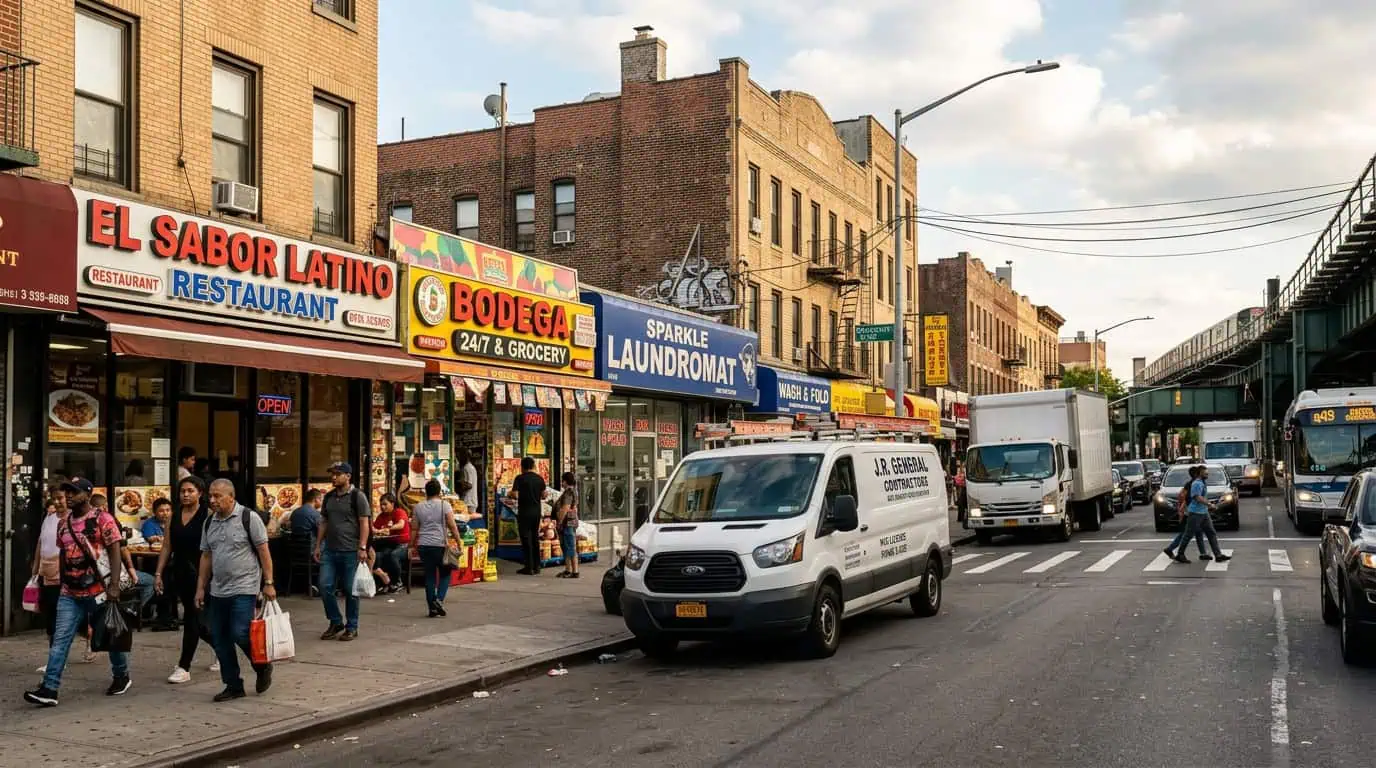
Commercial coverage needs vary by industry and by the work a business actually performs. Describe your operation to K&N and ask which available insurers and coverages may fit.
Restaurants & Food Service
GL, workers’ comp, commercial property, liquor liability (if serving alcohol), food spoilage coverage, and business interruption. Restaurants face among the highest claims frequency of any industry — slip-and-fall injuries, kitchen burns, foodborne illness, and employee injuries are all common. New York City restaurants must also comply with Health Department requirements that often reference insurance.
Contractors & Construction
Contractors may need GL, workers’ compensation where required, commercial auto, tools and equipment coverage, or builder’s risk, depending on the job. Contracts may specify limits and endorsements. Review the work, workers, vehicles, and contract requirements before choosing coverage.
Retail Stores
Retail businesses may consider a BOP (GL + property), workers’ compensation where required, and product liability if relevant to their operation. Compare an actual BOP proposal with separate coverage at the same limits, deductibles, and exclusions.
Professional Services
Professional liability (E&O) can address covered errors in professional work; general liability and cyber insurance address different risks. Accountants, lawyers, consultants, architects, and IT providers should review their actual services, client contracts, data handled, and policy terms to decide which coverages fit.
Delivery & Logistics
Commercial auto for business-owned vehicles and other work use as the policy requires, GL, cargo insurance, and workers’ comp. Delivery fleets face high accident frequency in NYC traffic, cargo damage claims, and driver injury exposure. Fleet discounts are typically available for 5+ vehicles.
Real Estate & Landlords
Landlord insurance may address building damage, premises liability, and lost rent after a covered loss; umbrella coverage may add limits above eligible underlying policies. For a multi-family or commercial rental, review the actual occupancy, property type, limits, deductibles, exclusions, and vacancy terms before choosing coverage.
Why Use a Broker for Commercial Insurance?
Commercial insurance is more complex than personal insurance. Policies have exclusions, sub-limits, and industry-specific endorsements that can leave you exposed if not configured correctly. Here’s why a broker matters:
- Compare available options. Ask which insurers can review your operation, what information they require, and how their actual proposals differ.
- Industry-specific terms. Ask which endorsements, exclusions, and limits apply to the actual work your business performs.
- Certificates of Insurance (COIs). Ask for a certificate after policy and certificate-holder details are confirmed. A COI evidences insurance; it does not change policy coverage. Timing depends on the request and required approvals.
- Claim questions. Ask who receives claim notice, what documents the insurer needs, and how to check claim progress.
- Review changing needs. When revenue, staff, vehicles, locations, or contracts change, ask whether your current limits and coverages still fit.
Learn more about how an independent broker works and how brokers differ from agents.
Commercial Insurance Guides
Explore our detailed guides for each type of commercial coverage:
Coverage Types
- Commercial Auto Insurance in New York — fleet, delivery, hired/non-owned
- General Liability Insurance in New York — bodily injury, property damage, COIs
- Business Owners Policy (BOP) — GL + property package; compare actual terms
- Workers’ Compensation in New York — check applicable WCB rules
- Landlord Insurance — rental property protection
By Location
By Industry
Related
Frequently Asked Questions About Commercial Insurance in New York
What commercial insurance is required in New York?
Workers’ compensation is generally required for businesses with covered employees in New York, subject to specific exemptions and classification rules. Business-owned vehicles generally need a commercial auto policy; other work use depends on the vehicle and policy terms. General liability may be required by a lease or contract; check your actual obligations. Disability benefits coverage may also be required; check the NY Workers’ Compensation Board.
How much does commercial insurance cost for a small business in New York?
There is no reliable single monthly price for every small business. Request actual quotes for the same operation and coverage, then compare premiums, limits, deductibles, exclusions, and policy conditions. Workers’ compensation classification, vehicle ownership and use, and property details can change the result.
What is a Business Owners Policy (BOP)?
A BOP commonly packages general liability and commercial property coverage in one policy; included coverages and eligibility vary. It may cost less than comparable separate policies for some businesses, but no fixed discount is assured. Compare actual proposals at the same limits, deductibles, and exclusions. Learn more about BOPs.
Do I need commercial auto insurance or is personal auto enough?
A business-owned vehicle generally needs commercial auto insurance. For a personally owned car used for work, tell the insurer who owns it, who drives it and how it is used. A personal policy may allow some work use or may exclude it. Coverage and any claim depend on the actual policy and facts; ask the insurer or broker to confirm the fit before relying on it.
What happens if I don’t have workers’ compensation in New York?
If New York workers’ compensation coverage is required and missing, the consequences depend on the facts and applicable law. The Workers’ Compensation Board describes civil penalties, potential criminal penalties, and responsibility for benefits in uninsured claims. Check the Board’s current coverage and exemption rules for your business rather than assuming one fixed penalty.
Do you offer commercial insurance in Spanish?
Sí — nuestro equipo habla español, inglés, árabe, francés y ruso. Muchos dueños de negocios en Queens y Long Island prefieren discutir su cobertura comercial en español. Llámanos al (718) 739-9090 para hablar sobre seguro comercial.
What is a Certificate of Insurance (COI) and how do I get one?
A COI is a certificate that evidences insurance information; it does not amend or expand the policy. A landlord, client, or contractor may request one. Contact K&N with the certificate-holder and policy details, and ask what can be issued and when. Timing depends on the request, policy status, and any required approvals.
Can I bundle all my business insurance into one policy?
Not necessarily. A BOP may package general liability and property coverage, but eligibility and included coverages vary. Workers’ compensation, commercial auto, and professional liability may require separate policies or endorsements depending on the insurer and operation. Compare actual proposals showing what is packaged, what remains separate, and the limits, exclusions, and premiums for each option.
What Our Clients Say

4.9 ★★★★★
936+ Google reviews across all locations
Commercial Auto Insurance — Other States
K&N Insurance Brokerage is licensed to write commercial auto insurance in multiple states. Ask K&N which options are available for a business operating outside New York.
Ready to protect your business?
Discuss available commercial insurance options with K&N and compare actual quote terms. Hablamos español.
Two Office Locations Serving New York Businesses
Queens Office
182-03 Jamaica Ave, Hollis, NY 11423
Phone: (718) 739-9090
Hours: Mon-Fri 9-6, Sat 10-5
Huntington Office
1730 E Jericho Tpke, Huntington, NY 11743
Phone: (631) 646-9090
Hours: Mon-Fri 9-6, Sat 10-5
Email: [email protected] | Toll-free: (833) 840-8500
General small-business guidance: NY Department of Financial Services, NY Workers’ Compensation Board, NAIC, and III. Actual requirements, coverage, and pricing depend on business facts and policy terms.
Related Guides