
On-Hook Coverage — The Heart of a Tow Policy (And When You Don’t Need It)
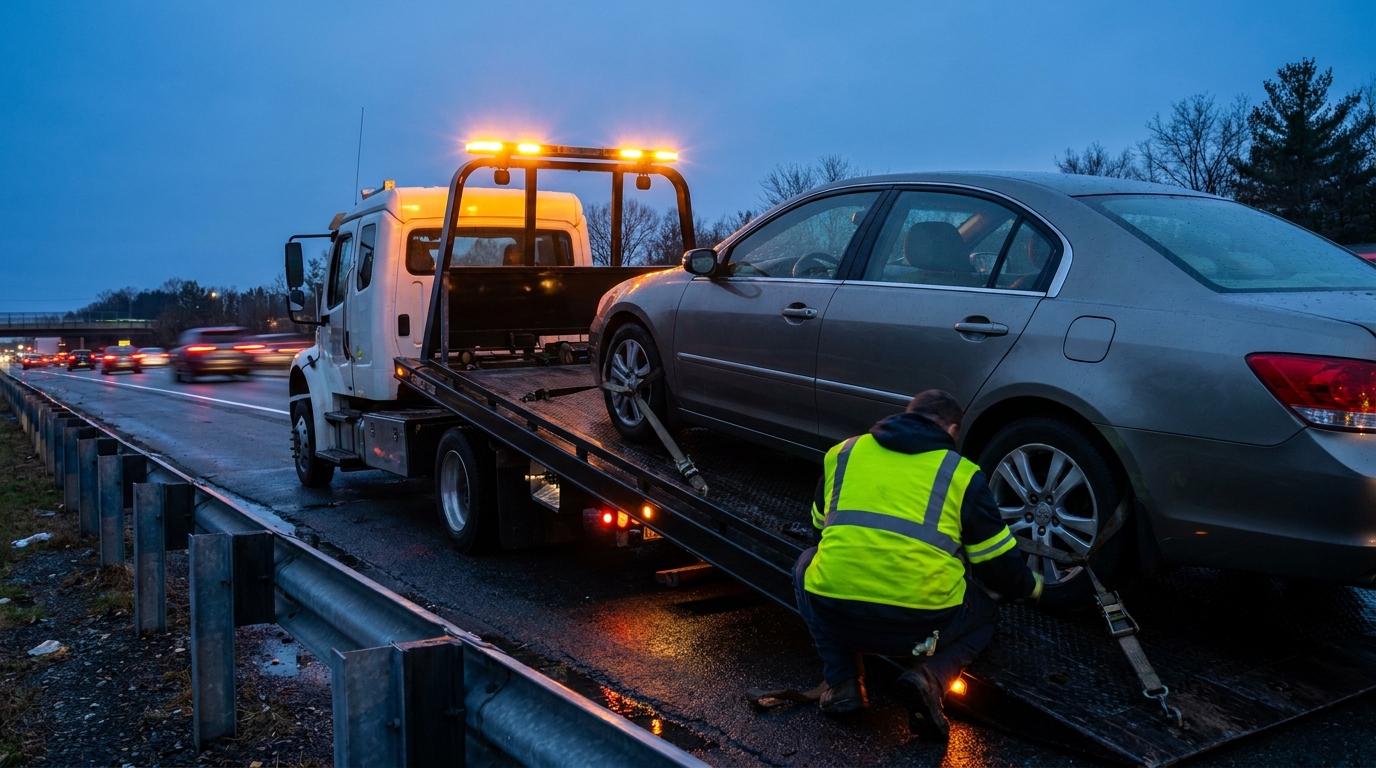
On-hook coverage pays for physical damage to vehicles you’re towing — the customer’s car on your flatbed. In our quoting, limits of $25,000-$50,000 with a $1,000 deductible are the common shape. It’s the coverage that makes a tow policy a tow policy.
Here’s the money-saving nuance most operators never hear: if you only tow your own vehicles, you may not need on-hook at all. A body shop shuttling its own repair jobs, a dealer or resale operation moving its own inventory — that’s your property, covered differently and often far cheaper. We’ve re-quoted operators substantially lower on exactly this distinction. Related but different: garagekeepers coverage protects customer vehicles in your lot or shop, not on your hook — many operations need both, some need neither. Two questions on the first call sort it out.
Tow Plates in New York — Why the Insurance Bar Is Higher
Registering with tow plates commonly requires liability around a $300,000 combined single limit plus on-hook coverage of about $25,000 — well above what an ordinary commercial registration demands, and priced accordingly. Whether you actually need tow plates depends on how you operate: “not for hire” operations moving their own vehicles face a different bar than public towing. Getting this fork right before you register saves both premium and DMV headaches.
| Operation Type | Typical Insurance Shape |
|---|---|
| Public / for-hire towing (roadside, police rotation) | Tow plates; ~$300K CSL + ~$25K on-hook commonly required; highest rate class |
| Body shop / dealer moving own vehicles | “Not for hire” — on-hook often unnecessary; substantially cheaper when structured right |
| Repo / transport mix | Depends on contracts — bring them; misdescribing this is a decline trigger |
| Storage lot alongside towing | Add garagekeepers for customer vehicles in your care |
Declined by Other Carriers? Towing Draws More Declines Than Any Vehicle Type We Quote
Tow operations get declined more than any other commercial-auto class we handle — usually over DOT operating history, violations on the record, or a DOT filing that misdescribes the operation (we’ve seen operators filed as “general freight” who actually tow their own vehicles — a fixable mismatch that reads as a red flag to underwriters). A declined application isn’t the end: it’s usually a misdescribed one. We re-frame the risk accurately and take it to carriers that actually write towing. When the standard market truly won’t bite, New York’s assigned-risk plan exists as the backstop — expensive, but legal to operate on while we work you back to the standard market.
One more pattern from our files: if a disputed old accident is inflating your record, a Letter of Experience from the prior carrier is the standard remedy. Ask us how to request one.
Cost Reality + What to Have Ready
For-hire tow trucks in the NY metro commonly quote from roughly $600 to $1,400+ per month in our experience depending on plates, radius, driver records, and DOT history — own-vehicle-only operations materially less. Down payments typically run 20-40% of annual premium. Indicative ranges as of 2026, not a quote.
- VIN + title for every truck
- How you actually operate — for-hire vs own vehicles, storage lot or not, police rotation or not
- DOT number + filing history (bring the mismatches — we fix those)
- Driver licenses, DOBs, and abstracts if violations are in play
- EIN for business-name policies; prior declaration pages or a Letter of Experience
Registering tow plates on a deadline? Call (718) 739-9090 — same-day binding with documents in hand is routine.
Tow Truck Insurance — Questions From Real NY Operators
Do I need on-hook coverage if I only tow my own vehicles?
Often not — your own property is covered differently, and dropping unneeded on-hook is one of the fastest legitimate ways to cut a tow quote. The moment you tow anyone else’s vehicle for money, though, on-hook becomes essential. Be precise about which one you are.
What insurance do New York tow plates require?
Commonly around a $300,000 combined single limit plus roughly $25,000 of on-hook coverage — significantly more than a regular commercial registration, which is why tow plates cost more to insure. Whether you need tow plates at all depends on your operation type; ask before you register, not after.
What’s the difference between on-hook and garagekeepers?
On-hook covers customer vehicles while you’re towing them. Garagekeepers covers customer vehicles sitting in your lot or shop. A tow operation with a storage yard usually needs both; a body shop that only shuttles its own jobs may need neither.
I’ve been declined twice. Is it over for me?
No — towing declines are usually about how the risk was described, not the risk itself. A DOT filing that says “general freight” when you tow your own vehicles, an unexplained violation, a disputed accident without a Letter of Experience — all fixable framing problems. And the assigned-risk plan keeps you legal while we fix them.
Does my personal auto policy cover a tow truck side business?
No — and this one ends badly at claim time. Towing for money is commercial use of a commercial-class vehicle; no personal policy or endorsement stretches that far. Here’s the full breakdown of where personal coverage actually ends.
Do you sell towing service or roadside assistance?
No — we’re an insurance brokerage. This page is about insuring tow trucks. If your car needs a tow, contact a towing company; if your personal policy should have covered a tow and didn’t, that’s a coverage conversation we can help with.
Wreckers, Flatbeds, Fleets — Described Right, Priced Right.
Declined elsewhere welcome. 934+ Google reviews.
K&N Insurance Brokerage Offices
Queens: 182-03 Jamaica Ave, Hollis, NY 11423 — (718) 739-9090
Huntington: 1730 E Jericho Tpke, Huntington, NY 11743 — (631) 646-9090
Mon-Fri 9-6 • Sat 10-5 • Toll-free (833) 840-8500
Related guides: Commercial Auto in NY • Dump Truck Insurance • Box Truck Insurance • NY Lapse & Plate Rules
Registration and plate requirements per the NY DMV; commercial insurance oversight per the NY DFS. Limits and cost figures reflect K&N Insurance Brokerage’s quoting experience as of 2026 and vary by carrier and operation; not an offer of coverage.
Keep Exploring